

Prepare your first CSRD sustainability statement for FY2027 with a structured, expert-guided reporting process.Our expert guide helps sustainability teams manage double materiality assessments, identify relevant ESRS disclosure requirements, coordinate data collection responsibilies and make confident reporting decisions.
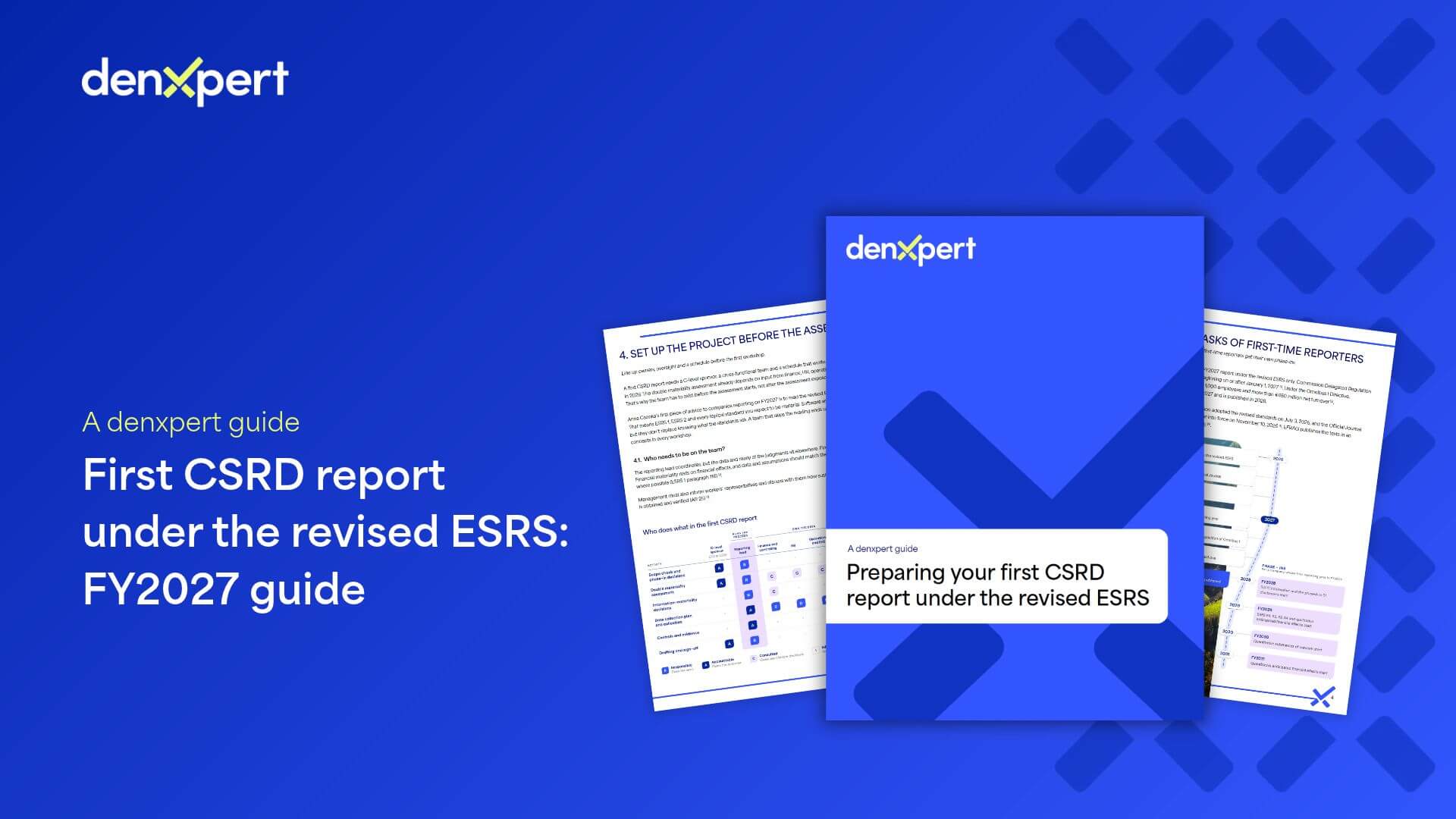
CSRD reporting Guide for your first report under revised ESRS
Prepare your first CSRD sustainability statement for FY2027 with a structured, expert-guided reporting process.
Our expert guide helps sustainability teams manage double materiality assessments, identify relevant ESRS disclosure requirements, coordinate data collection responsibilies and make confident reporting decisions.
Preparing your first CSRD report? Download our practical guide to scope, top-down materiality, data collection and assurance under the revised ESRS.
Make CSRD reporting more manageable
Your first CSRD report requires more than collecting sustainability data. Your team needs to understand which requirements apply, determine which sustainability matters are material, coordinate information across departments and prepare disclosures that can withstand scrutiny.
The revised European Sustainability Reporting Standards (ESRS) aim to simplify reporting while maintaining the quality of sustainability information. The European Commission adopted the revised standards in July 2026, with application for financial years beginning on or after 1 January 2027 under the applicable rules.
With denxpert CSRD reporting software, you can organise the reporting process around your company's material topics and disclosure requirements instead of managing disconnected spreadsheets, documents and email threads.
From double materiality to an audit-ready sustainability statement
Guided double materiality assessment
Identify and assess your company's impacts, risks and opportunities through a structured double materiality assessment. Use built-in guidance, examples and stakeholder collaboration tools to document your methodology and decisions.
Structured ESRS disclosure management
Turn your materiality assessment into a reporting project based on the relevant disclosure requirements. Work through disclosures systematically with plain-language guidance, application requirements and documented reasoning.
Centralised data collection and collaboration
Coordinate reporting across business units, sites and departments. Assign disclosure owners, monitor progress and bring narrative reporting together with relevant sustainability data through denxpert's connected data solution.
Traceable, audit-ready reporting
Maintain a clear record of reporting decisions, disclosure versions and user activity. Document why particular disclosures or datapoints were included or excluded and provide controlled access for reviewers and auditors.
Expert guidance throughout the process
Combine software with structured onboarding, in-platform guidance, educational resources and access to sustainability expertise. Give your team the support it needs to establish a repeatable reporting process.
Built for the realities of CSRD reporting
Less time coordinating. More time on the substance.
- Replace fragmented spreadsheets and documents with a central reporting workspace.
- Establish clear ownership of disclosure requirements and reporting deadlines.
- Reduce duplicate work through structured data management and reusable reporting content.
- Improve consistency by documenting decisions and keeping reporting information organised.
- Build internal reporting capabilities that can support future reporting cycles.
Prepare for revised ESRS with a practical reporting guide
First CSRD report under the revised ESRS: FY2027 guide
Not sure where to begin with your first CSRD sustainability statement? Start with a practical guide to the reporting process.
Download the free guide to understand how to approach the key stages of preparing your first report under the revised ESRS.
Inside the guide, you'll learn how to:
- Understand reporting scope and the requirements relevant to your company.
- Approach double materiality from a top-down perspective.
- Organise sustainability data collection across your organisation.
- Prepare for assurance and establish a more structured reporting process.
Whether you are building your CSRD process from scratch or refining an existing approach, this guide helps you translate reporting requirements into practical next steps.
Why use denxpert for CSRD reporting?
CSRD reporting is a cross-functional process that connects sustainability expertise, operational data, management decisions and external assurance.
denxpert combines sustainability reporting software with practical implementation guidance to help teams manage that complexity in one structured environment.
A reporting process built around ESRS. Organise your work around material topics and relevant disclosure requirements.
One central workspace. Coordinate reporting activities, responsibilities, documentation and progress.
Traceability throughout the process. Keep reporting decisions and changes documented for review and assurance.
Support beyond the software. Access onboarding, guidance and sustainability expertise when your team needs it.
Designed for ongoing reporting. Reuse relevant content and build on previous work to make subsequent reporting cycles more manageable.
Frequently asked questions about CSRD reporting software
What is CSRD reporting software?
CSRD reporting software helps companies organise the processes involved in preparing sustainability statements under the Corporate Sustainability Reporting Directive. Depending on the solution, this includes double materiality assessments, ESRS disclosure management, data collection, collaboration, documentation and audit-trail management.
denxpert structures the narrative reporting process around material disclosure requirements, with numeric sustainability data managed through its connected ESG data solution.
What are the revised ESRS?
The European Sustainability Reporting Standards define the sustainability information companies within the relevant CSRD scope must report. The revised ESRS adopted by the European Commission in July 2026 simplify the standards, reduce datapoints and introduce additional flexibilities. Companies should determine which version applies to their reporting period and circumstances.
When should companies prepare their first CSRD report under the revised ESRS?
For companies subject to the applicable reporting requirements, the revised ESRS apply to financial years beginning on or after 1 January 2027. The reporting timetable and scope depend on the company's circumstances and the applicable legislation. Companies preparing for FY2027 should establish their reporting process, assess material topics and plan data collection in advance.
How does CSRD software support a double materiality assessment?
CSRD software can guide teams through identifying and assessing impacts, risks and opportunities, coordinating stakeholder input, documenting methodology and connecting material topics to relevant ESRS disclosure requirements. denxpert provides structured guidance and collaboration features to support this process.
Can CSRD reporting software help prepare for assurance?
Software can help prepare for assurance by keeping reporting information organised, documenting decisions and maintaining traceability across the reporting process. denxpert supports audit preparation through a comprehensive audit trail, controlled access and documented reporting rationale. The use of software does not replace independent assurance.
Is CSRD reporting software suitable for multinational companies?
A central reporting workspace can help multinational organisations coordinate reporting across sites, business units and departments. denxpert supports multi-site data collection, disclosure ownership, role-based access and collaboration across reporting teams.
Start building your CSRD reporting process
Prepare for your next sustainability reporting cycle with a clearer process for double materiality, ESRS disclosures, data coordination and documentation.
Book a denxpert demo to see how the software can support your reporting workflow, or download the free FY2027 CSRD guide to explore the key steps in preparing your first report under the revised ESRS.



FAQ

CSRD, part of the 2020 Green Deal, sets rules for large corporations in the EU to report on sustainability. It aims to improve transparency and accountability. The EU has approved the directive, and reporting obligations start in 2024.
The main reason to introduce the CSRD is to guide companies towards implementing more sustainable business practices. Sustainability reporting is important for businesses to stay competitive in the long run.
- It enhances the attractiveness of companies to investors by bolstering Environmental, Social, and Governance (ESG) reporting.
- CSRD provides a structured framework for companies to chart their sustainable journey, aiding in goal setting and progress tracking.
- Compliance leads to reduced reporting costs and alleviates the burden of responding to numerous data requests.
- Adherence to common reporting standards under CSRD positions companies favorably in global markets, enhancing their competitive edge.
- Companies gain deeper insights into the environmental and social impacts of their supply chains, aiding more informed decision-making.
- By mandating comprehensive reporting, CSRD acts as a deterrent against greenwashing and ensures transparency in sustainability achievements.
The necessity for the Corporate Sustainability Reporting Directive (CSRD) stems from glaring deficiencies in the current landscape of sustainability reporting data. Some companies don't share sustainability info, and those that do often use long, complicated PDFs to present it.
Quality concerns further compound this issue, with sustainability reports frequently lacking in detail or reliability. Subjective decision-making by companies regarding which areas to disclose exacerbates the challenge of comparing and analyzing sustainability reports.
Moreover, existing rating systems built on sustainability criteria yield disparate ratings for companies, causing confusion for both companies and investors alike. Difficulty in accessing information about suppliers and customers further burdens companies with substantial costs for data collection and sustainability reporting.
With these challenges in mind, it is important to improve regulations and increase transparency in companies' sustainability practices. This goal is to improve sustainability reporting data, making it easier to make informed decisions in all areas.
ESRS, approved by EFRAG, sets rules for companies to report on sustainability impacts, opportunities, and risks. This is in accordance with the EU's new Corporate Sustainable Reporting Directive (CSRD). https://finance.ec.europa.eu/news/commission-adopts-european-sustainability-reporting-standards-2023-07-31_en
A term used in sustainability reporting that brings environmental impacts into the focus of standard-setting in accounting. A company should disclose information that is material and that "a reasonable person would consider important."
The double materiality concept states that a sustainability issue can be important for two reasons. The first reason is its impact. The second reason is the risks and opportunities it presents.
Double materiality now considers stakeholders, meeting the needs of both shareholders and other groups involved in a company. This approach integrates both the "Outside-In" and "Inside-Out" perspectives, each representing a distinct materiality viewpoint.
The latest draft of ESRS (November 2022 – ESRS 1 General requirements) emphasizes the concept of double materiality. ESRS 1 delineates double materiality into two dimensions: impact materiality and financial materiality. As defined by the Global Reporting Initiative (GRI), double materiality unites impact materiality and financial materiality.
1. Impact materiality
The evaluation begins by examining how businesses affect the environment, society, and governance over different time periods. This includes the short, medium, and long term impacts. Sustainability issues encompass impacts originating from any segment (upstream or downstream) of the entire supply chain. While severity determines materiality concerning negative impacts, potential negative impacts also require consideration of their likelihood, factoring in scale, scope.
2. Financial Materiality
Financial materiality arises when a corporate sustainability impact becomes financially significant or relevant for investors and lenders. ESRS underscores the importance of risks or opportunities significantly influencing cash flow, performance, and financial or market position.
3. Other materiality concepts
Researchers have dismissed new ideas about materiality, such as "dynamic materiality," "core materiality," and "nested materiality." Instead, we prefer the concept of double materiality for its clarity.
Double materiality considers both financial and non-financial impacts on a company's performance. This approach provides a more comprehensive understanding of a company's materiality. It helps stakeholders make more informed decisions about the company's sustainability and long-term success.
ESRS, with EFRAG's help, helps companies follow consistent guidelines to share their sustainability impacts, opportunities, and risks. This alignment with the EU's CSRD aims to streamline reporting practices across the European corporate landscape.


